· Michele Mazzucco · Post · 11 min read
Queueing strategy 101: why layout matters more than you think
From checkout counters to digital support lines, your queue layout directly impacts wait times, efficiency, and customer satisfaction. Here is how to get it right.
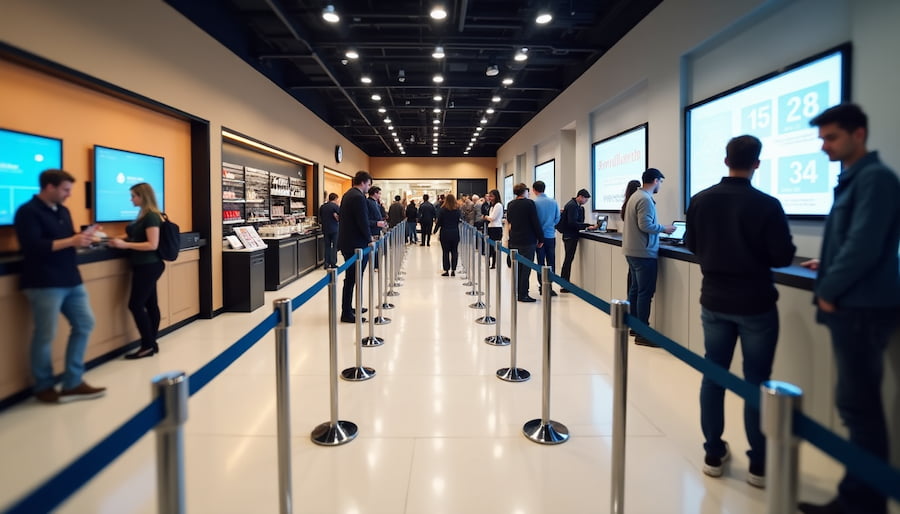
Imagine entering a busy grocery store or arriving at a bustling airport check-in area. You might see multiple lines, each leading to a separate counter. Now picture a different scenario—a single, organized line that feeds all service counters. Which system works better, and why?
Customers hate waiting, but how we structure that wait can make all the difference. One long line or many short ones?
In this article, we will break down the key differences between single and multiple queues, explore their advantages and drawbacks, consider real-world constraints, and discuss how these strategies apply beyond physical scenarios.
Table of contents
- Choosing the right queue layout for your business
- Single queue (pooling resources)
- Multiple queues
- Considering advanced queueing strategies
- Beyond physical queues
- Implementing the right queueing system for your business
- Industry-specific queue layout examples
- ⚠️ Avoiding common layout mistakes
- Conclusion
Choosing the right queue layout for your business
The right queue layout makes a huge difference in how happy your customers are and how smoothly your operations run. Your business needs a system that matches several key factors which shape both waiting times and customer experience.
Factors to think over: space, staff, and customer type
A well-designed queue starts with your available space. Wider areas work great for serpentine layouts, while narrow spaces need more compact setups. Studies reveal that poor queuing systems create overcrowding, unwanted customer contact, and reduced staff productivity. The system must address:
Customer demographics
Retail shoppers with full carts need more space than airport travelers with carry-ons
Staff availability
More service points mean you’ll need extra employees
Peak traffic patterns
Your layout should handle varying crowd sizes
Safety requirements
Crowded spaces raise health and safety issues
Clear entrances and exits stop cross-flow traffic and boost efficiency and safety. As we have discussed in previous articles, the psychology of waiting shapes customer perception - customers care about how they feel while waiting, not just the actual wait time.
Single queue (pooling resources)
In this setup everyone waits in a single line and is served by the next available agent. This strategy, shown in Figure 1, is efficient, streamlined, and—most importantly—fair.
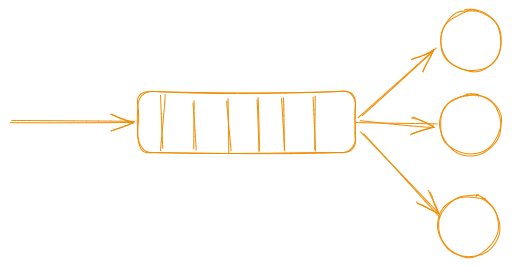
Pooling resources is a widely recommended strategy in queueing theory, providing several distinct advantages:
🙂 Fairness
Customers are served strictly on a first-come, first-served basis, ensuring fairness and transparency. Also, this setup removes the stress of picking the “wrong” line.
⏱️ Reduced waiting times
As we have shown in our previous article, while single queues might look longer, they move faster because they spread out the delay from slow transactions instead of holding up one specific line.
📢 Improved resilience
Single queues absorb sudden spikes in demand or service delays more efficiently than multiple separate queues.
📊 Predictability
Customers can see the line moving continuously, reducing frustration and improving the perceived waiting experience.
On the other hand single queues require careful space planning and clear signage to prevent confusion and ensure efficient flow, particularly in physical environments.
Multiple queues
Multiple queues, see Figure 2, mean each service point has its own independent queue.
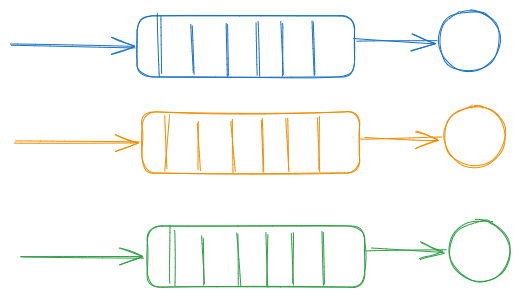
It can feel faster—when your line moves quickly, it’s satisfying. But pick the wrong one, and frustration builds fast.
While single-line queues have their perks, multi-line systems really shine in certain situations. Multi-line setups excel when:
🛺 Space runs tight
Several shorter lines use space better than one long serpentine queue. Small retail stores, coffee shops, and fast-food places benefit from this approach.
👟 Simplicity
Easy to implement and understand, requiring minimal coordination and setup.
😎 Customer choice
Multiple lines let people feel more in control, which reduces “balking” - when customers see a long line and leave without service.
🤓 Specialization
Banks and airports use separate lines for different services, letting specialized staff handle specific transaction types.
🚀 Express service matters
L-shaped queues with express lanes serve premium customers or those with fewer items well, especially in airports, small banks, and grocery stores.
Nevertheless, multiple queues often result in:
🚧 Uneven wait times
Some customers experience significantly longer waits due to slower-moving lines.
🛎️ Reduced resource efficiency
Independent queues can’t share available capacity, leading to wasted resources if one queue is empty while another is overloaded (later in this article we discuss how to tackle this problem).
😤 Increased customer frustration
Customers may perceive unfairness when later arrivals are served first, negatively impacting satisfaction.
Considering advanced queueing strategies
In the real world, queues are rarely one-size-fits-all. When stakes are high—whether for customer experience or service quality—more advanced queueing strategies can make a meaningful difference.
🔀 Priority queues
Instead of treating every customer the same, systems can separate traffic by value, urgency, or service tier. A common example is offering VIP or express lanes for high-value users. This ensures that critical requests are served faster—even when demand spikes.
We have covered this approach in depth in our priority-based resource allocation case study.
🧮Resource reservation and Overflow models
You may want to reserve a portion of your capacity for certain users, services, or time periods—ensuring that essential workloads aren’t delayed by less important traffic.
To maintain efficiency, systems can also implement overflow routing—where waiting customers are temporarily redirected to underused resources in other queues.
Our resource reservation article dives into this concept with real-world examples and performance data.
These strategies are more complex than standard FIFO (first-in, first-out) queues—but they offer huge benefits under pressure:
- Fewer abandoned transactions
- Better fairness and customer satisfaction
- More predictable performance during peak load
🔍 Overflow queues: letting one line help another
Beyond physical queues
Queueing decisions extend beyond physical environments. From call centers to concert ticket platforms and even theme parks, digital queues help shape customer experiences and operational outcomes.
🎢 Disney’s theme parks have long used virtual queues to improve guest experiences—letting visitors reserve a spot on popular rides and enjoy other attractions instead of standing in line. It’s a perfect example of queue decoupling in action.

Overflow models, virtual waiting rooms (also known as virtual queues), and digital queue interfaces play a crucial role in managing spikes and improving user experience. As discussed in our article on digital queue abandonment, managing expectations is just as important as managing traffic.
Done well, digital queueing improves fairness, reduces abandonment, and preserves operational stability. For example, some businesses enhance physical experiences with digital signage—displaying real-time wait times to help customers choose the best line. Others go fully virtual, redirecting users to an online queue that shows live position updates, estimated wait times, and branded messaging.
This type of traffic management isn’t just a technical fix—it’s a strategic decision. If you are exploring virtual queueing options, we have written an in-depth guide on selecting the right virtual waiting room solution—including key features, use cases, and vendor comparisons.
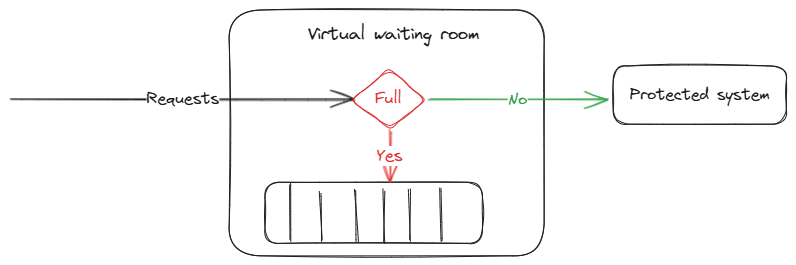
🔍Want to know how virtual queues work in practice?
Implementing the right queueing system for your business
Regardless of which approach you choose, there are several key considerations to keep in mind when implementing a queuing system. First and foremost, it’s essential to understand your customers’ needs and preferences. By gathering feedback and data on their experiences, you can tailor your queuing system to meet their expectations.
Additionally, you should also consider the specific needs of your business. For example, if you have a high-volume environment, you may need to implement a more efficient queuing system that can handle a large number of customers. On the other hand, if you are offering a more complex or customized service, you may need to implement a more flexible queuing system that can accommodate varying levels of demand.
🧠 Key takeaways
- Separate queues may look fair, but they are often inefficient.
- Single queues offer better performance—especially under load.
- Overflow and virtual waiting rooms add flexibility without redesigning everything.
- Queue structure is not cosmetic—it directly impacts performance and customer experience.
💡 Need help choosing the right queue layout for your business? Let’s talk.
Industry-specific queue layout examples
Different industries need specific queue layouts that match their operations and what customers expect. The right setup helps businesses run smoothly and keeps customers happy.
🛒 Retail: checkout lanes and impulse zones
Smart retailers use queue design to turn wait time into revenue. Checkout areas connect customers with businesses directly—and when impulse items are placed strategically along the path, they can boost sales by up to 400% and raise margins by 30%.
Some key design principles:
- Single serpentine lines that encourage last-minute purchases
- Clear signage guiding shoppers to checkout
- Express lanes for customers with fewer items
- Highlighted displays featuring high-margin or seasonal goods
Products placed in queue zones see a sales lift of over 25%. For many stores, these are among the most valuable square meters of floor space.
🏥 Healthcare: triage and appointment flow
Healthcare queueing isn’t just about efficiency—it’s often a matter of urgency. Triage protocols prioritize patients based on condition severity, while queue management systems streamline the flow of appointments and walk-ins.
Modern systems allow patients to check in digitally, receive priority routing (e.g., for elderly, pregnant, or disabled patients), and see live updates on wait times. Digital check-in reduces paperwork, while real-time data helps allocate staff and resources dynamically—especially during peak hours or emergencies.
🏛️ Government offices: token systems and waiting areas
Government offices handle high volumes of traffic—and long waits. Token systems, now mostly digital, give citizens a queue position without requiring them to physically line up.
Digital displays and automated kiosks streamline check-ins, payments, and simple form submissions. Comfortable, accessible waiting areas and online appointment scheduling reduce stress and help both visitors and staff use time more effectively.
⚠️ Avoiding common layout mistakes
Queue layouts can fail even with careful planning if common pitfalls go unnoticed. Good queue management needs constant watchfulness to prevent design mistakes that upset customers and hurt operations.
🚧 Overcrowding and poor signage
Poorly placed barriers and confusing signage create bottlenecks and frustration. Inaccessible layouts—where signs aren’t visible, instructions are unclear, or exits are blocked—can worsen delays and safety risks.
Frequent signage issues include:
- Low contrast or hard-to-read colors
- Text overload
- Bad placement (not at eye level or natural stopping points)
- Lack of accessibility considerations for people with disabilities
Well-designed signs reduce staff intervention, improve customer flow, and make queueing intuitive.
🧠Ignoring customer psychology
Customer satisfaction depends heavily on the psychology of waiting, yet many businesses overlook this vital aspect. Research proves that empty time feels longer than busy time, which is why giving people something to do while they wait matters so much.
People get more frustrated when they don’t know why they’re waiting compared to delays with clear explanations. Not knowing how long the wait will be turns early optimism into mild frustration and then real anger. People who wait too long often take more time once served, which creates a cycle of growing delays.
These psychological missteps don’t just frustrate customers—they lead to lower satisfaction, poorer conversion rates, and more staff effort to “calm the queue.”
📈Lack of flexibility for peak times
Fixed designs that can’t handle changing crowd sizes rank among the worst layout mistakes. Queue setups that don’t adjust can’t manage unexpected visitor surges, and chaos with long waits follows.
Flexible layouts—with modular paths, retractable barriers, and staff-controlled shortcuts—help absorb peak-time demand without chaos. Combine this with data-driven scheduling to anticipate surges and staff accordingly.
Conclusion
Queue management works best when businesses blend smart layout decisions with modern tech to create a smooth customer experience. Single-line systems shine at fairness and shorter wait times. Multi-line setups and advanced hybrid strategies have their merits, particularly under specific operational constraints or priorities.
Smart queue design reaches beyond the physical setup. The focus stays on customer psychology, adaptability during rush hours, and what each industry needs. Digital tools like queue systems, mobile apps, and up-to-the-minute updates reshape traditional waiting into simplified processes that help customers and staff alike.
Your business deserves the best queue setup. Each company faces its own unique challenges.
🚀 Reach out to us for tailored strategies that match your needs.
The path to success starts with picking the right mix of physical layout and digital tools for your situation. A well-planned system built on proven methods will cut wait times, boost customer happiness, and accelerate your business growth.
📬 Get weekly queue insights
Not ready to talk? Stay in the loop with our weekly newsletter — The Queue Report, covering intelligent queue management, digital flow, and operational optimization.