· Michele Mazzucco · Post · 11 min read
When efficiency backfires: the strategic cost of over-optimizing queues
Everyone loves efficiency—until it backfires. Over-optimization erodes customer trust, burns out employees, and creates fragile systems. This article explores the paradox of queue management and introduces the Balance Ratio as a tool to find the right equilibrium between speed and satisfaction.
Executives love efficiency—it’s measurable, repeatable, and easy to celebrate. Shorter waits, higher throughput, lower costs—who wouldn’t want that?
But in the race to optimize, many organizations cross an invisible line where efficiency starts working against experience. Customers feel rushed, employees burn out, and the system becomes fragile. The gains look great on paper—until loyalty, trust, or resilience collapse.
Welcome to the paradox of modern queue management: the moment when doing things right starts going wrong.
Table of contents
- 1. The efficiency-experience trade-off
- 2. The efficiency-experience curve
- 3. Introducing the Balance Ratio (BR)
- 4. Case studies: when efficiency backfires
- 5. Why do organizations over-optimize?
- 6. How to do it right: strategies to balance efficiency and experience
- 7. From efficiency to effectiveness
- Conclusion
1. The efficiency-experience trade-off
At its best, efficiency reduces friction and improves service flow. Yet beyond a certain point, additional optimization yields diminishing — or even negative — returns.
Research in operations and service design shows this pattern consistently. For example, recent McKinsey insights on retail and consumer experience (McKinsey — State of the Consumer 2025, McKinsey — Bloomingdale’s case study) highlight that while automation and queue streamlining can improve throughput by 20–30%, customer satisfaction often falls when perceived human attention drops below a certain threshold. Similarly, airline industry reports and IATA publications (IATA Airlines Magazine, IATA — Passenger Facilitation) show that highly optimized boarding or check-in processes can create frustration if passengers feel rushed or disoriented, even when total boarding time decreases.
As we have discussed in several articles before (e.g., see here), the reason is that queues are not just mechanical systems — they are emotional experiences. A “faster” queue that feels stressful, unfair, or opaque isn’t really faster to the person waiting in it, as highlighted by research from the Journal of Service Research:
Perceived wait time can outweigh actual wait time
2. The efficiency-experience curve
Figure 1 depicts the relationship between efficiency and customer experience:
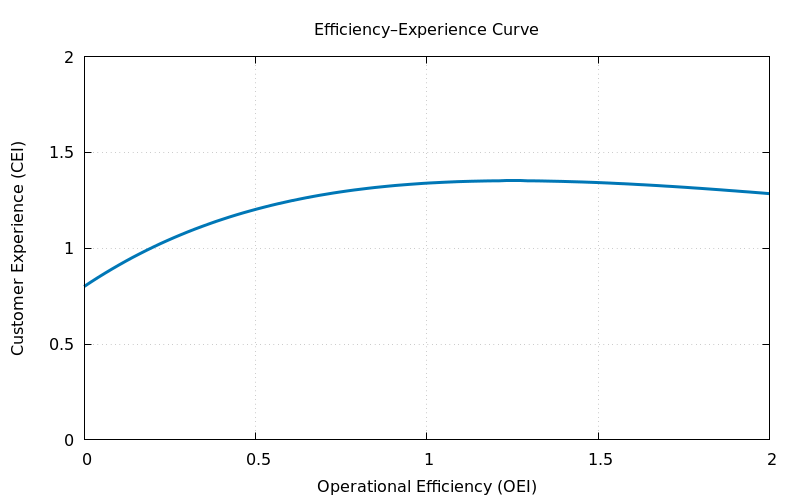
On the horizontal axis, efficiency — throughput, utilization, or cost per served unit. This is captured by the Operational Efficiency Index (OEI), which measures how well resources are used to achieve outputs, considering cost per unit, throughput, and utilization (more details about OEI can be found at KPIdepot — Operational Efficiency Index).
On the vertical axis, customer experience — satisfaction, perceived fairness, loyalty. This is represented by the Customer Experience Index (CEI), a composite score reflecting how customers perceive their experience, blending sentiment, loyalty, and friction across all touchpoints (see Forrester — CX Index for more details about CEI).
At first, as efficiency rises, experience improves too. Waits shorten, and processes feel smoother. But then, the curve bends. Each new gain in efficiency produces smaller experience benefits — until eventually, the relationship inverts.
That inflection point — the efficiency-experience tipping point — is where optimization turns into over-optimization. The pattern has been studied in perceived-wait literature (e.g., see David H. Maister — The Psychology of Waiting Lines).
3. Introducing the Balance Ratio (BR)
The above two metrics are well known individually, but their combined use to monitor the efficiency-experience balance is less common. To help you visualize when optimization crosses into diminishing returns, we propose the Balance Ratio (BR):
BR is a deliberately simple, conversation-friendly metric that maps your organization to a point on the Efficiency–Experience curve above.
Both CEI and OEI should be normalized to a common baseline (baseline = 1.0) so the ratio is comparable over time. As a rule of thumb:
BR ≈ 1.0— Efficiency and experience are roughly in equilibrium.BR < 0.7— Efficiency is growing faster than experience; you may want to investigate perceived wait, employee load, and exception rates.BR > 1.2— Experience is improving faster than efficiency; you may have excess capacity or be under-leveraging resources.
Importantly, BR is a diagnostic conversation tool, not a universal Key Performance Indicator (KPI). It prompts the question: “Are our efficiency gains delivering the experience we expect?” — and points to where deeper diagnostics are needed.
Two practical tips for effectively using BR are:
- Compute
BRperiodically (e.g., weekly) and use rolling averages (e.g., 3–8 weeks) to reduce volatility. - When
BRflags imbalance, run a short diagnostic — measure perceived wait, interview frontline staff, and run a small stress test or add micro-buffers at critical handoffs.
The formula we introduced above is very simple, and therefore limitations and caveats apply. In particular, small-sample CEI signals can make BR noisy. If that is the case, you should combine BR with qualitative signals such as surveys, NPS comments, or frontline interviews. Also, large, transient changes in OEI such as outages or campaign spikes can distort BR briefly — hence make sure to always check the context.
To summarize, while BR is intentionally simple, its power is in guiding the right questions and nudging teams toward balanced decisions—not in replacing careful, context-specific analysis.
4. Case studies: when efficiency backfires
To illustrate this paradox in action, we discuss two real-world examples where over-optimization led to unexpected consequences: one customer-facing, one internal.
4.1 The airport check-in paradox
In 2023, several major airports rolled out AI-driven check-in and security scheduling tools, aiming to cut average waiting time by 25%. On paper, the results were stellar: throughput improved, and queues appeared shorter.
Passenger feedback, however, told a different story. Industry reporting and surveys (see IATA — Passenger Facilitation and SITA — Passenger IT Insights 2024) show that overall satisfaction can decline when efficiency improvements remove perceived “control” — passengers feel rushed through unclear self-service checkpoints, with little opportunity for human support when things go wrong.
Our Balance Ratio would have flagged this early: OEI rises, but CEI drops, pushing BR below 0.7. That imbalance signals a hidden risk: efficiency is cannibalizing trust.
The lesson, here, is to optimize for flow, not just speed. A process that feels hurried can damage perceived fairness and transparency—the psychological anchors of a good queue. When speed trumps experience, loyalty and trust erode.
4.2 The warehouse throughput trap (composite case)
The same trap appears in internal operations. The vignette below is a composite and anonymized case drawn from industry reporting and internal audits and investigative reporting such as The Guardian — ‘I’m not a robot’). It captures a recurring pattern rather than a single named organization.
A logistics provider implemented advanced load-balancing algorithms to squeeze an extra 15% capacity from its warehouse queues. Forklifts were re-routed dynamically, idle time nearly vanished, and daily volume rose.
Three months later, employee turnover jumped 18%. Supervisors reported higher error rates and missed shipments. An internal audit traced the issue to over-optimization: the system was so tight that even minor disruptions cascaded into chaos. Workers described the environment as “relentless—no buffer, no breathing room.”
Here, the efficiency-experience curve turned sharply downward. Productivity KPIs improved, but morale and accuracy collapsed—creating rework that erased the original gains. The solution wasn’t less optimization, but re-balancing: reintroducing micro-buffers and adjusting algorithms for variability tolerance. Optimizing for flow and human well-being, not just speed, restored stability.
As one manager summarized:
We made the queue faster, but we broke the people running it.
🎯 Similar patterns have been reported by workers in high-efficiency environments like Amazon warehouses and delivery operations, where relentless optimization can lead to stress, burnout, and a fragile system that struggles to absorb disruptions.
5. Why do organizations over-optimize?
After these examples, you may wonder why organizations fall into the over-optimization trap. Three reasons stand out:
- Measurement myopia: KPIs like average handle time or utilization reward efficiency, not experience. What’s easier to measure gets over-valued, while harder-to-quantify factors like trust and morale are ignored. For example, Amazon’s relentless focus on efficiency has led to an annual employee turnover rate of approximately 150%, which is double the industry average. This means more workers leave the company each year than the total number of employees. The hidden cost of this massive churn is estimated to exceed $8 billion per year, impacting not only morale and operational resilience, but also the company’s bottom line.
- Local optimization: Teams improve their part of the process without seeing the system-wide impact—creating bottlenecks or new pain points elsewhere.
- Cultural inertia: Efficiency is seen as inherently good, so pushing harder rarely triggers internal debate until damage surfaces.
Ironically, these same organizations often spend heavily later on CX recovery, employee engagement initiatives, or system redesign—trying to undo the collateral effects of their earlier “success.”
With this understanding of the pitfalls, let’s explore how to do it right: strategies to balance efficiency and experience.
6. How to do it right: strategies to balance efficiency and experience
6.1 Finding the right balance
True optimization means balancing three dimensions, efficiency, experience, and resilience. Over-optimizing one often degrades the others.
| Dimension | Question to ask | Symptom when over-optimized |
|---|---|---|
| Efficiency | Are we minimizing waste and maximizing flow? | Overload, burnout, brittleness |
| Experience | Are we improving satisfaction and trust? | Drop in NPS, complaints, churn |
| Resilience | Can we absorb variability without failure? | Fragility, cascading errors |
Thanks to the Balance Ratio, you can easily assess if you are moving along this three-way equilibrium or drifting toward imbalance. Use it to spark debate and course-correct before damage is done.
6.2 Practical steps to avoid over-optimization
Avoiding the trap of over-optimization requires a shift in perspective: from chasing isolated metrics to fostering a holistic system that honors both performance and humanity. The rationale is to embed efficiency within a broader framework of empathy, foresight, and continuous learning. Here is how to get started.
Begin by prioritizing perception over precision. While actual wait times are easy to measure, perceived wait—how long the experience feels—often matters more. Customers and employees alike crave control, transparency, and fairness, which can outweigh even the fastest service. For instance, a queue that provides clear updates and options for flexibility might feel more satisfying than one that’s technically quicker but opaque.
Next, balance your metrics to capture the full picture. Don’t just track throughput and utilization; pair them with real-time indicators of satisfaction, such as abandonment rates or sentiment scores—like the simple happy/unhappy face buttons at airport security gates or public office kiosks, where people rate their wait time or facility cleanliness. This dual instrumentation reveals imbalances early, allowing you to adjust before efficiency erodes experience. Imagine monitoring both the speed of a checkout line and the smiles (or frowns) of those in it—only then can you see if your optimizations are truly benefiting everyone.
Stress testing is another critical tool in your arsenal. Regularly simulate disruptions, like a sudden influx of customers or a system glitch, and observe how your queues hold up. If minor issues trigger widespread chaos, your processes are likely too rigid. Building in buffers and redundancies ensures resilience, turning potential breakdowns into manageable hiccups.
People are the most important asset of any business, and frontline staff play a pivotal role in sustaining balance and adapting to real-world challenges. Empower them to adapt by giving authority to pause automated flows or reroute customers when noticing confusion or bottlenecks—like allowing a supervisor to override a self-service kiosk during peak hours. While algorithms handle averages well, real-world queues are full of exceptions. By enabling staff to exercise judgment through flexible protocols, you improve variability handling, boost morale, and transform rigid efficiency into adaptive flow.
Finally, commit to ongoing reflection. As your organization grows and technology evolves, what constitutes “optimal” changes. Revisit your KPIs regularly—quarterly or even monthly—to ensure they align with current realities. Automation might shift the balance point, requiring you to recalibrate for sustained effectiveness.
In essence, these steps aren’t a rigid checklist but a foundation for a more thoughtful approach. By weaving efficiency into a tapestry of experience and resilience, you create queues that don’t just move people faster—they move them better, fostering loyalty and long-term success.
7. From efficiency to effectiveness
The key lesson from the paradox of over-optimization is this: efficiency is a means, not an end. The goal should be effectiveness—delivering value that matters, not just speed or cost reduction. While you should always seek to improve efficiency, this exercise should be done holistically, as queues are part of an experience ecosystem that includes human emotion, digital friction, and operational resilience.
A truly modern queue strategy recognizes that speed is only one form of value. The others—fairness, transparency, empathy—are harder to measure but just as powerful to manage.
💡 For a deeper dive into measuring fairness in queues, see our previous article on Queue Equity: the overlooked KPI that erodes trust.
Conclusion
When efficiency backfires, it is rarely because leaders were careless—more often, it is because they were too focused on the wrong success signals. The smartest organizations now ask a deeper question:
Are we designing for speed, or are we designing for satisfaction?
That distinction defines not only the quality of your queues—but the quality of your brand.
📬 Get weekly queue insights
Not ready to talk? Stay in the loop with our weekly newsletter — The Queue Report, covering intelligent queue management, digital flow, and operational optimization.